Suno vs Udio: How Music AI Credits Compare
Both vendors sell music generation by the credit, and both publish the credit totals. Suno's free tier grants 50 credits a day; Udio's grants 10 a day inside a hard 100 a month. Paid tiers land within a fraction of a cent of each other per credit. What neither pricing page states is how many credits one song consumes, read October 14, 2026.
This article is a documentation review: it is based on the vendors' own published pages, checked on the date shown. We may earn a commission from some links; it never affects what we recommend.

Suno and Udio price AI music the same way, in monthly credits that do not roll over, and both print the credit totals on the pricing page. The free tiers are where they diverge: Suno lists 50 credits per day with no monthly ceiling stated, while Udio lists 10 credits per day inside a hard cap of 100 credits per month. On paid plans the unit cost converges, and Udio is the only one of the two that publishes a top-up rate you can use to value a credit. This guide reads both official pricing pages, checked October 14, 2026, and reports what is published and what is not.
The free tiers are not the same size
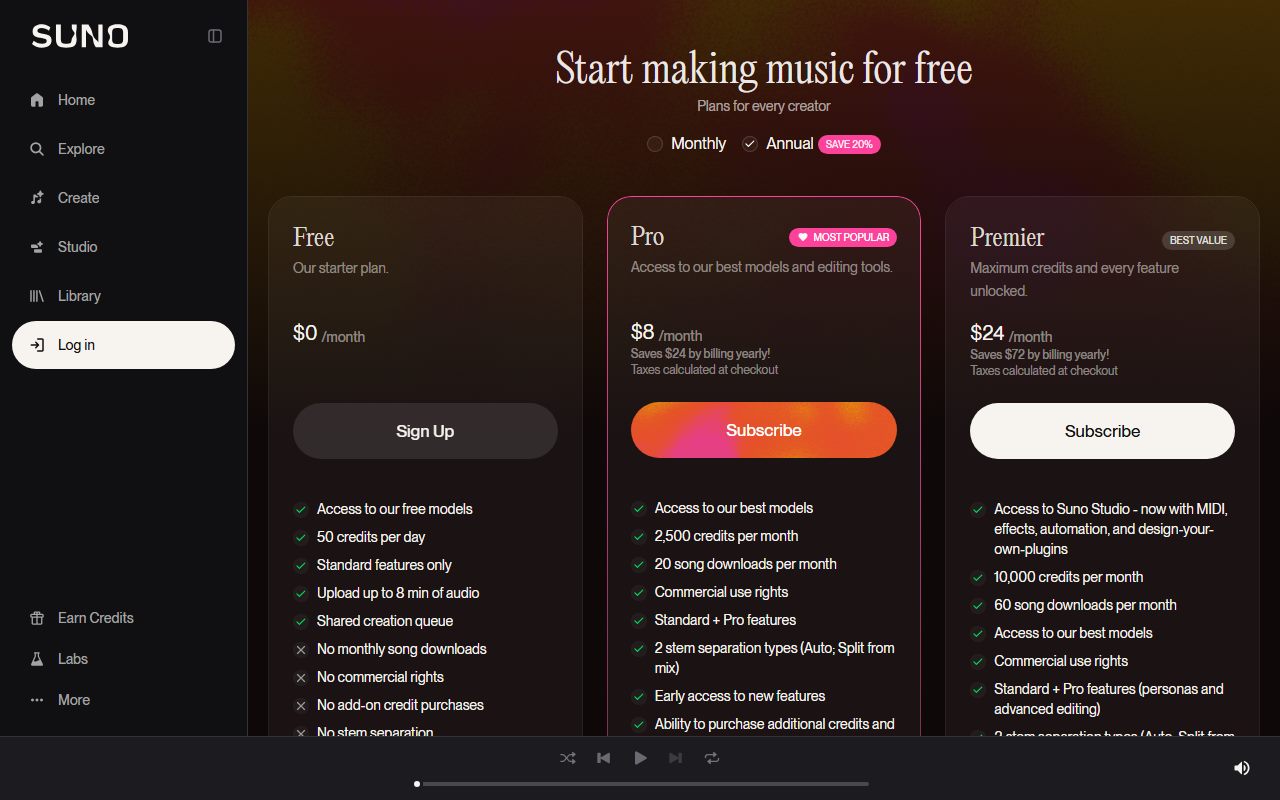
Suno's free plan is listed at $0 per month with "50 credits per day." The page states no monthly ceiling on the free tier, only the daily figure, alongside "Standard features only" and a "Shared creation queue."
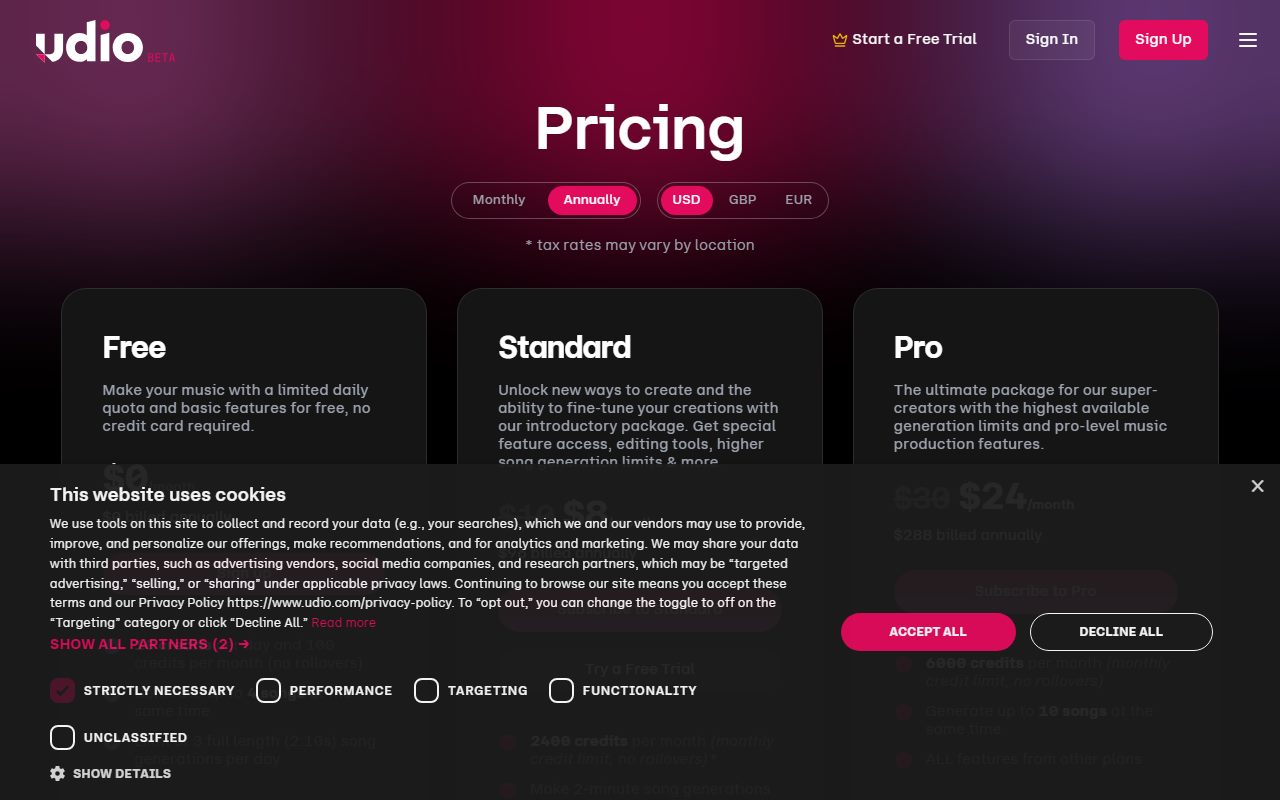
Udio's free plan is listed at $0 per month with "10 credits per day and 100 credits per month (no rollovers)." The monthly number is the binding one, because 10 per day for 30 days would be 300.
By editorial calculation, a Suno free user who used the daily grant every day for a month would reach roughly 1,500 credits, against Udio's hard 100. That is a fifteen to one gap on paper before any question of what a credit buys.
Udio attaches a second free-tier limit that Suno does not: "Limit of 3 full length (2:10s) song generations per day." The comparison table restates it as "Create 130 second songs 3 per day," with 32 second songs unrestricted.
- Suno Free: $0, 50 credits per day, 4 concurrent generations in a shared queue, no commercial rights, no monthly song downloads, no add-on credit purchases, no stem separation, audio uploads up to 8 minutes.
- Udio Free: $0, 10 credits per day and 100 per month with no rollovers, up to 4 songs at the same time, three full-length generations per day.
- Suno Pro: $8 per month, 2,500 credits per month, 20 song downloads per month, commercial use rights, priority queue up to 10 songs at once.
- Udio Standard: $8 per month billed annually at $96, or $10 monthly, 2,400 credits per month with no rollovers, up to 6 songs at the same time.
- Suno Premier: $24 per month, 10,000 credits per month, 60 song downloads per month, audio uploads up to 30 minutes, access to Suno Studio.
- Udio Pro: $24 per month billed annually at $288, or $30 monthly, 6,000 credits per month with no rollovers, up to 10 songs at the same time.
Paid credits cost close to the same per unit
At the entry paid tier the two products are nearly identical on paper. Suno Pro lists 2,500 credits for $8 per month; Udio Standard lists 2,400 credits for $8 per month when billed annually.
By editorial calculation that is about $0.0032 per credit on Suno Pro and about $0.0033 on Udio Standard. The difference is noise, not a reason to choose.
The top tiers separate more clearly. Suno Premier lists 10,000 credits for $24 against Udio Pro's 6,000 for the same $24, which works out to roughly $0.0024 per credit against $0.0040.
Those are not comparable units, and that is the trap. A Suno credit and a Udio credit are each defined by their own vendor, so a lower price per credit only matters if a credit does the same amount of work, which neither page establishes.
The same unit problem runs through every tool in this category, as set out in our note on how to read an AI credit pricing page and in how AI credits work at Jasper, Copy.ai, Synthesia and Pictory.
Udio publishes a top-up rate, which values a credit
Udio's pricing page lists two credit packs: "Purchase 100 credits - $3.00" and "Purchase 1000 credits - $25.00." Suno's page mentions the "Ability to purchase additional credits and downloads" on paid plans but prints no pack price.
By editorial calculation, Udio's packs work out to $0.030 and $0.025 per credit, roughly seven to eight times the per-credit rate inside the Standard subscription.
That gap is the honest signal in Udio's pricing. The subscription is the cheap channel and the top-up is the expensive one, so a project that habitually overruns its allowance is better served by the next tier up than by packs.
Suno's rollover language is the firmest sentence on either page: "Credits included in subscriptions do not carry over from day to day or month to month. Purchased top up credits do not expire, but require an active subscription to use." Udio marks each paid tier "no rollovers" in the same spirit.
Neither page we read says what one song costs
The number a buyer actually needs is credits per generation, and it is absent from both pricing pages. Suno prints credit totals without a per-song rate. Udio prints credit totals and a daily song limit, but not the credit cost of a generation.
Udio does list a question titled "What is a credit?" in its pricing FAQ. The answer is inside a collapsed accordion that did not render when we read the page on October 14, 2026, so we cannot report what it says.
We are not claiming the vendors publish nothing anywhere. We are reporting that the figure is not on the pricing pages we read, which is where a buyer looks for it.
Until that rate is in front of you, treat both credit totals as relative sizes within one vendor, never as a cross-vendor comparison. Vendors that do print hard per-unit caps, such as the meeting tools in Otter and Fathom free plan limits, are far easier to budget against.
Suno's second meter is downloads, not credits
Suno runs a limit that Udio's page does not mention at all. The free plan states "No monthly song downloads," Pro lists "20 song downloads per month" and Premier lists "60 song downloads per month."
Read that next to the credit totals. Pro grants 2,500 credits and 20 downloads, so on Suno the number of finished tracks you can take away is governed by the download meter long before the credit meter runs dry.
Commercial rights follow the same line. Suno's free plan is marked "No commercial rights," and both paid tiers carry "Commercial use rights," with the page pointing to the terms of service for limits.
Stem separation is tiered too: none on free, "2 stem separation types (Auto; Split from mix)" on Pro, and three types on Premier including "Advanced split." Anyone planning to mix the output should treat that as the real tier divider, much as voice and editing features split the tools in ElevenLabs and Descript audio credits.
Suno's annual discount is printed two ways
Suno's billing toggle carries a badge reading "Annual save 20%." The plan cards on the same page say "Saves $24 by billing yearly!" for Pro and "Saves $72 by billing yearly!" for Premier.
The monthly option was the selected one when we read the page, showing $8 and $24. By editorial calculation, $24 off a $96 year is 25 percent, and $72 off a $288 year is also 25 percent, not the 20 percent on the badge.
We are not picking a side. Both figures are on the page as of October 14, 2026, so confirm the annual total at checkout before committing a year.
Udio avoids the problem by printing both numbers in each card: "$10" struck through beside "$8 /month" and "$96 billed annually" underneath. That is the clearer pattern, and the one more pricing pages should copy.
Which one to buy
Pick on the limits that will stop you, not on the credit count. The queue, the download cap and the upload length will bite before the credit balance does for most buyers.
- Choose Suno Pro if you need commercial rights cheaply, want a priority queue of up to 10 concurrent songs, and 20 downloads a month is enough.
- Choose Suno Premier if you want Suno Studio with MIDI and effects, 30 minute audio uploads, or more than 20 finished tracks a month.
- Choose Udio Standard if you want 2 minute generations without the three-a-day cap and prefer a published top-up rate over an unpublished one.
- Choose Udio Pro if 10 concurrent generations and 6,000 credits matter more than Suno's larger credit pool.
- Stay free on Suno for casual use, because 50 credits a day is a usable allowance against Udio's 100 a month.
One more thing both pages share: the free plans are shaped to be tested, not used. That is the normal pattern in this market, and it is the same read we reached on Claude Free, Pro and Max and on Grammarly's free prompt limits.
Frequently asked questions
How many credits does Suno's free plan give?
Fifty credits per day, per the pricing page checked October 14, 2026. No monthly ceiling is stated on the free tier, and included subscription credits do not carry over from day to day or month to month.
How many credits does Udio's free plan give?
Ten credits per day inside a cap of 100 credits per month, with no rollovers. Free users are also limited to three full-length generations of about 2 minutes 10 seconds per day.
Which is cheaper, Suno Pro or Udio Standard?
Both list $8 per month, Udio's when billed annually at $96. Suno includes 2,500 credits against Udio's 2,400, so the unit cost is within a fraction of a cent by editorial calculation.
How many credits does one song cost?
Neither pricing page states it. Udio lists a "What is a credit?" question whose answer sits in a collapsed panel that did not render when we read the page on October 14, 2026, so we cannot report the figure.
Can you buy extra credits?
Yes on both, but only Udio publishes the rate: 100 credits for $3.00 and 1,000 for $25.00. Suno lists the ability to buy additional credits on paid plans without printing a pack price.
Do unused credits roll over?
No. Suno states that included credits do not carry over from day to day or month to month, and Udio marks every paid tier's monthly allowance "no rollovers." Purchased Suno top-ups do not expire while a subscription is active.
Do the free plans allow commercial use?
Suno's free plan is marked "No commercial rights," with commercial use rights on Pro and Premier subject to the terms of service. Udio's pricing page does not set out commercial rights per tier.
Bottom line
On price per credit these two products are close enough to be a coin toss at the entry tier, and Suno is cheaper at the top. The choice turns on the secondary meters instead: Suno's download cap and Udio's daily generation cap.
Udio earns a point for printing a top-up rate, which is the only number on either page that lets you value a credit in dollars. Every figure here is as of October 14, 2026, so re-read both pages before you commit to an annual term.
Sources
- Suno pricing, plan prices, credit allowances and comparison table (checked Oct 14, 2026)
- Udio pricing, plan prices, credit allowances and credit packs (checked Oct 14, 2026)