AI Coding Plans: Five Checks Before You Buy
Five AI coding vendors were read on the same day, and no two of them sold usage in the same unit. One prices a credit at a cent, one at two cents, one sells multiples of an unpublished base, one hands out a refreshing quota and one meters in actual dollars with a disclosed markup. Here is what to check before paying for any of them.
This article is a documentation review: it is based on the vendors' own published pages, checked on the date shown. We may earn a commission from some links; it never affects what we recommend.

Five AI coding pricing pages were read with a headless browser on October 27, 2026. No two of them sold usage in the same unit, and only three published a unit at all.
That makes a side by side table close to useless. What survives is a short list of questions that any of these pages can be made to answer.
Each claim below links to the write-up where the figures and the source URL sit, so nothing here needs taking on trust.
The five units in use right now
It helps to name the shapes before judging them. The same product category is being sold in five incompatible currencies.
- A cent: GitHub Copilot states that 1 AI credit equals $0.01 and quotes allowances in dollars.
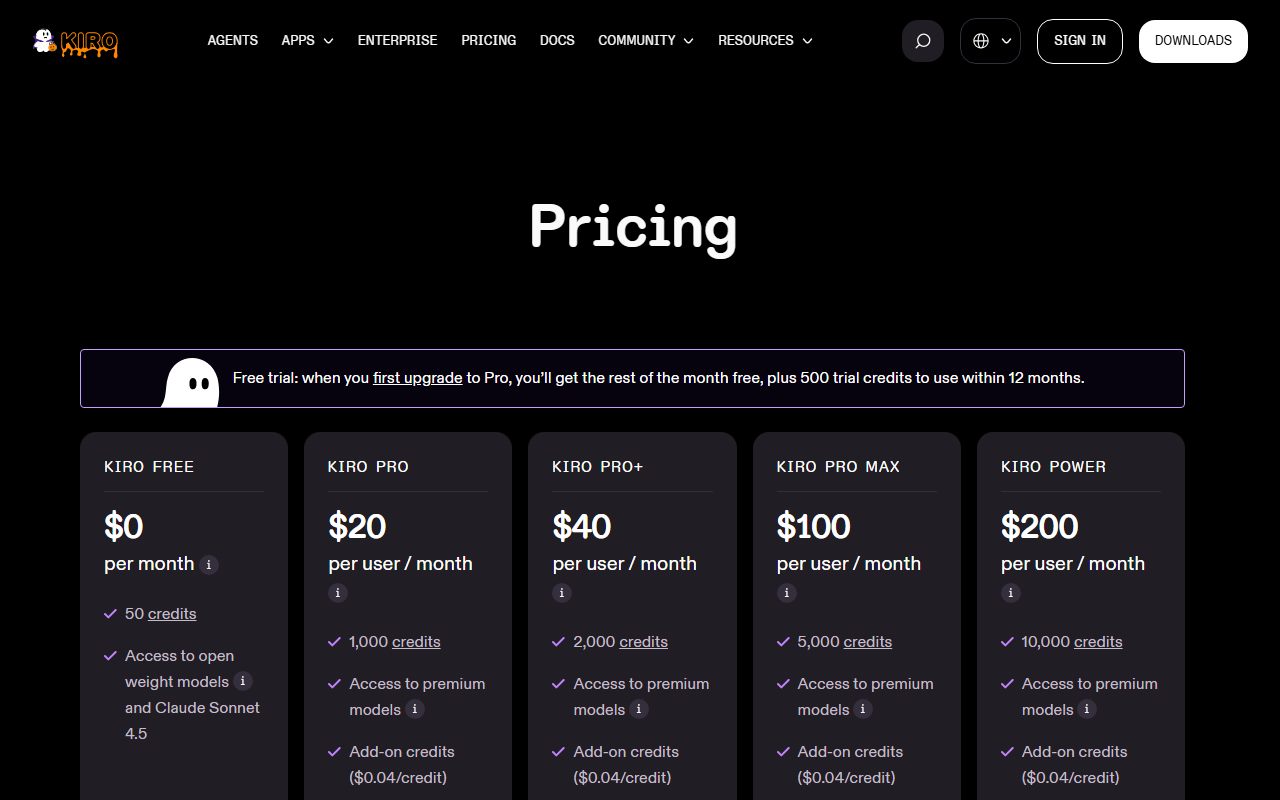
- A counted credit: Kiro prints 1,000 credits on Pro at $20, which is two cents each.
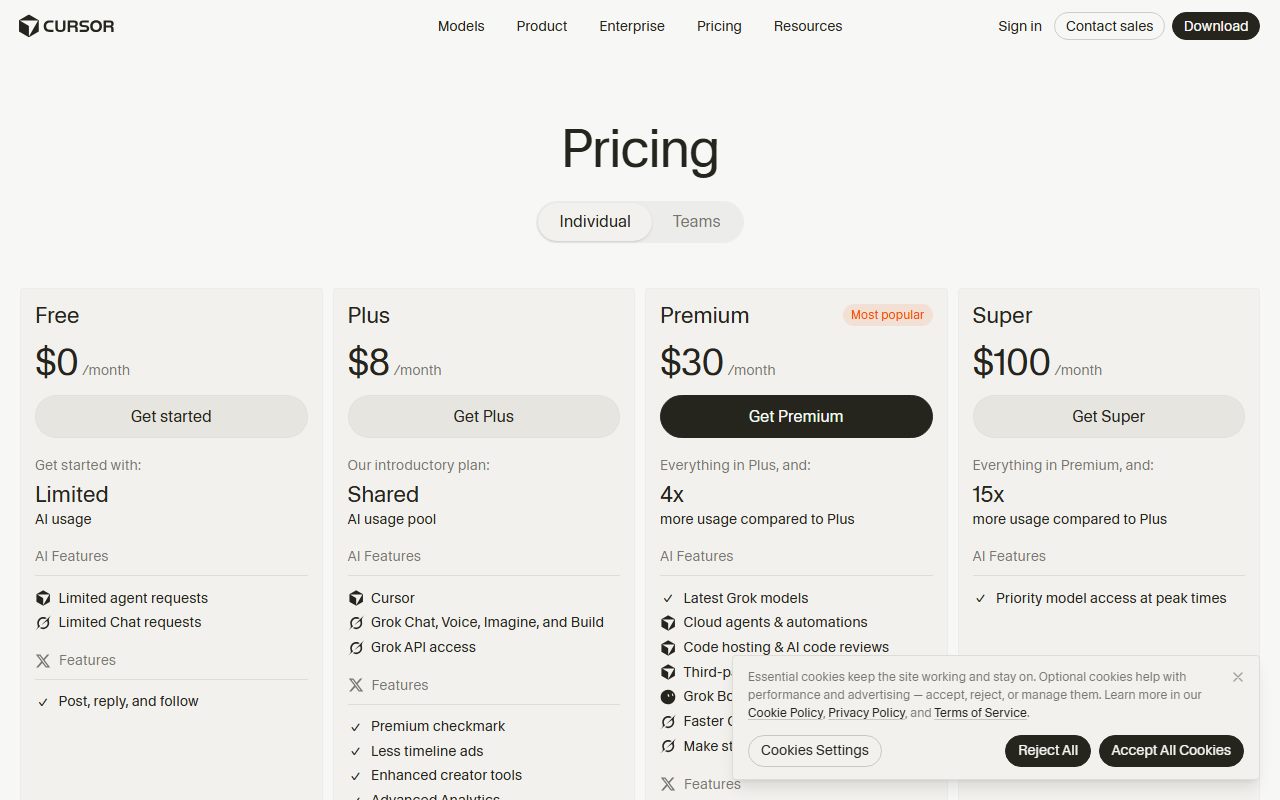
- A multiple: Cursor describes paid tiers as 4x, 15x or 50x of a Plus plan that has no published allowance.
- A refreshing quota: Devin gives paid plans an allowance that refreshes daily and weekly, with no number.
- A pooled dollar: Augment meters in actual dollars of inference at API list price plus a 40 percent fee.
Three of those can be put in a spreadsheet. Two cannot, and that is a fact about the vendor rather than about your requirements.
Check one: is there a unit, and is it published
Start here, because everything else depends on it. A page that names a unit and its price can be compared with your own API bill.
Copilot's cent per credit and Kiro's two cents both pass. Cursor's multiples do not.
A multiple of an unpublished base ranks tiers without pricing them. It is not dishonest, but it cannot be budgeted against, and no amount of reading fixes that.
Check two: what sits outside the meter
Every one of these five excludes something from the headline price, and the exclusions are where surprises live.
Copilot excludes code completions and next edit suggestions from the credit meter, which is generous: they stay unlimited on paid plans.
Cursor excludes third-party models from the monthly price entirely, billing them separately at API list price. That is an exclusion in the other direction.
Augment puts a flat 40 percent service fee on inference and none on compute, so the mix of your workload changes the effective rate.
Check three: does the allowance belong to a seat or a pool
This decides whether headcount or activity drives the bill, and the two vendors in Devin against Augment sit at opposite ends of it.
Devin charges $80 a month plus $40 per full dev seat, so ten developers is $480 a month by our arithmetic. Capacity arrives with each seat.
Augment charges $20 a month flat for up to 50 seats, with usage pooled. A dormant colleague costs nothing, and one heavy user can drain the pool.
Copilot keeps pooling off its individual plans entirely, listing pooled usage as not included on Free, Pro, Pro+ and Max. Kiro requires a subscription per developer.
Check four: what happens at the limit
Overage pricing is often clearer than plan pricing, and it reveals what the vendor thinks a unit is really worth.
Kiro sells add-on credits at $0.04, double its included rate of $0.02. On those numbers, moving up a tier beats topping up twice.
Copilot lets paid users set a dollar budget that draws down at $0.01 a credit. Devin and Augment both pass extra usage through at API pricing or as top-ups.
Carry-over is the other half of this question. Kiro states plainly that monthly credits do not roll over while purchased packs last 12 months; the rest of the field is mixed, as the rollover survey shows.
Check five: what else is in the seat
Two of these five bundle things that are not coding tools, which breaks any price per developer comparison.
Cursor's plans list Grok chat, image and video generation and account perks such as a premium checkmark and ad-free scrolling. Some teams value none of that.
Copilot's organisation tiers bundle audit logs, pooled spending controls and security features that a solo buyer will never use.
Unbundle before comparing. The same exercise applied to a productivity suite is in what Notion AI adds to a seat.
A note on how these figures were obtained
All five pages were rendered in a headless browser and the strings were read from the resulting document, then confirmed on a second render the same day.
That matters because several of these pages draw their price tables with script, so a plain fetch returns an empty shell and invites a wrong conclusion.
Where a figure could not be found as a real string, this cluster says so rather than describing the vendor as silent. Cursor's base allowance is the clearest example.
The same discipline applied to non-coding tools is in how AI credits work across Jasper, Copy.ai, Synthesia and Pictory.
Frequently asked questions
Which AI coding tool has the clearest pricing?
GitHub Copilot, on the pages we read. It publishes a unit price of $0.01 per AI credit, states each allowance in dollars, and gives a worked overage example in the same units.
Which is cheapest for a small team?
Augment Standard at $20 a month flat for up to 50 pooled seats, on sticker price. Devin's team structure reaches $480 a month at ten developers by our arithmetic.
Why do some pages give multiples instead of numbers?
It lets a vendor change capacity without changing the page. Cursor lists 4x, 15x and 50x of a Plus plan whose own allowance is described only as Basic.
Should I top up or upgrade when I run out?
Usually upgrade. Kiro charges $0.04 for add-on credits against $0.02 included, so Pro plus 1,000 extra credits costs $60 where Pro+ gives 2,000 for $40.
Do unused AI coding credits carry forward?
Rarely for plan credits. Kiro says monthly credits do not roll over while purchased packs last 12 months. Augment says top-ups are valid 12 months from purchase.
Is a free tier enough to evaluate these tools?
For completions, often. Copilot Free lists 2,000 completions a month and Devin Free lists unlimited Tab completions. Agent work is where the free quotas run out fast.
Bottom line
Ask for the unit first. If a page will not name one, treat the subscription as a floor and assume the real bill arrives later.
Then decide whether you are buying seats or activity. That single choice moves the annual figure more than any discount on this market does.
All figures read October 27, 2026. Related: what annual billing really saves and Claude Free, Pro and Max.
Sources
- GitHub Copilot plans and pricing (checked Oct 27, 2026)
- Kiro pricing, plans and credits (checked Oct 27, 2026)
- Cursor pricing, individual and team plans (checked Oct 27, 2026)
- Devin plans and pricing, served at windsurf.com/pricing (checked Oct 27, 2026)
- Augment Code pricing, Standard, Business and Enterprise (checked Oct 27, 2026)