AI Priced Per Outcome, Not Per Seat
Most AI pricing pages sell a bucket of credits. Intercom sells results, at $0.99 each, with a refund clause if the customer comes back.
This article is a documentation review: it is based on the vendors' own published pages, checked on the date shown. We may earn a commission from some links; it never affects what we recommend.
Most AI pricing pages sell you a bucket: credits, prompts, minutes. Intercom's sells something else. The seat is one price and the AI is billed per result it produces, at a figure printed in the page's own structured data.
That changes the arithmetic. A bucket caps your spend and caps your output at the same time. A per-outcome charge removes the ceiling in both directions, which is better on a quiet month and worse on a busy one.
Every figure below was read on Intercom's published pricing page and its help article on Fin outcomes, both checked October 31, 2026.
The seat price and the AI price are separate lines
The structured data on the pricing page lists three helpdesk tiers in US dollars. Essential is $29 per seat per month, Advanced is $99 and Expert is $139. Each carries the unit text SEAT_PER_MONTH.
Fin, the AI agent, sits in a fourth entry with the unit text PER_OUTCOME and a price of 0.99. The page's own wording is blunt: "Fin is priced at $0.99 per outcome."
The page also states that "All plans include access to Intercom and Fin AI Agent". So the agent is not a tier you upgrade into. It is a meter running alongside whichever tier you bought.
What Intercom counts as an outcome
This is the part worth reading twice, because the definition is the product. The page lists three triggers for a billable outcome.
- A customer confirms their issue is resolved.
- They do not ask for more help after Fin responds.
- Fin completes a workflow, which the page calls a Procedure, including handoffs.
The second trigger is the loose one. Silence counts. A visitor who reads Fin's answer and closes the tab has produced a billable outcome, whether or not the answer actually helped.
The third trigger bills a handoff. The page says a Procedure "designed to handoff to a human" still counts. Fin can therefore charge $0.99 for passing the conversation to your staff.
The refund clause is the one in your favour
Two published limits cut the other way. The first caps the charge per conversation rather than per message.
The page states: "You're only charged at most once per conversation, even if Fin takes multiple actions or answers multiple questions." A long thread costs the same as a one-line reply.
The second is a refund. The same sentence continues: "If the conversation is later reopened, the outcome is refunded." A customer who comes back unsatisfied undoes the charge.
Together those clauses make the meter closer to paying per resolved customer than per AI call. That is a different risk profile from the per-request meters in Browse AI credits.
Sales outcomes are priced ten times higher
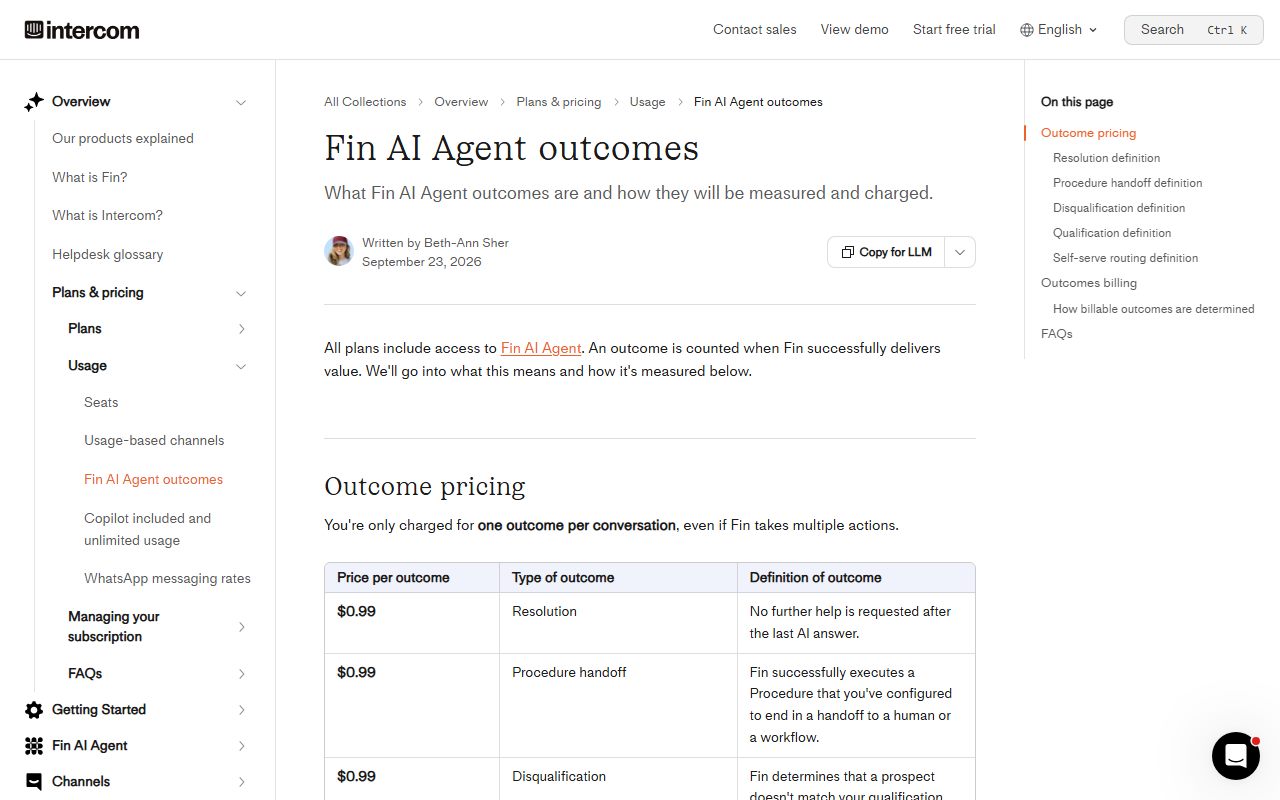
The page splits outcomes by what they achieve. At $0.99 it lists resolution, Procedure handoff and disqualification, the last being where Fin rules a lead out against your criteria.
One outcome costs far more. The page states "$9.99 per qualification" for the case where Fin "qualifies a lead to your sales criteria and routes them to your sales team, CRM, or elsewhere".
So ruling a lead out costs 99 cents and ruling one in costs $9.99, by editorial reading of that list. Voice is quoted separately: "Fin Voice is available via sales at $1.99 per voice outcome."
The help article adds a fifth type the pricing page does not name. Self-serve routing is "Billed at $0.99 per conversation - the lower per-qualification rate", and it warns that "Existing outcomes default to the full rate and are not repriced".
Two cases that are published as free
The help article names two conversations that do not bill. Both are the kind of edge case most vendors leave to support tickets, so it is worth quoting them.
The first is a greeting. The article states: "A resolution is only counted when Fin provides an actual answer to a customer's query. If Fin merely responds to a greeting, this is not considered an answer or resolution."
The second is an unanswered clarifying question. The article says that because "Fin's last message was a question rather than an answer, no resolution state is recorded and this is not a billable outcome".
The refund also runs further than the pricing page suggests. The article says a returning customer deducts the resolution "even across billing periods", so last month's charge can be reversed this month.
Where the maths favours a meter, and where it does not
Put the two lines against each other and the crossover is easy to find. By editorial calculation from the published prices:
- 30 outcomes a month cost $29.70, roughly one Essential seat.
- 100 outcomes cost $99, exactly one Advanced seat.
- 1,000 outcomes cost $990, more than seven Expert seats.
- 10 sales qualifications at $9.99 cost $99.90, about what 101 resolutions cost.
A team fielding a few hundred tickets a month will pay less than it would for extra headcount. A team fielding tens of thousands will find the meter outruns any seat count.
The pricing page says "Usage (e.g. Fin, messaging) is pay-as-you-go", with no ceiling quoted. Contrast that with the hard monthly limits in Grammarly free versus Pro and Perplexity free versus paid.
The help article is the one that offers a brake. It states you "can also set usage reminders and hard limits to ensure you're happy with how many resolutions Fin is able to provide". The limit is a setting, not a plan feature.
What neither page publishes
Two figures matter and do not appear on either page read here. There is no published minimum seat count, and no volume discount schedule for outcomes.
The article points high-volume buyers at sales instead: "For Fin Voice, high-volume pricing, or specialized needs, contact Sales". So the rate card above is a list price, and the discount curve is not public.
Frequently asked questions
How much does Intercom's Fin AI agent cost?
The pricing page states "Fin is priced at $0.99 per outcome", and its structured data lists 0.99 with the unit text PER_OUTCOME. Fin Voice is listed separately at $1.99 per voice outcome, available via sales. Checked October 31, 2026.
What counts as a Fin outcome?
The page lists three triggers: a customer confirms the issue is resolved, the customer does not ask for more help after Fin responds, or Fin completes a Procedure, including one designed to hand off to a human.
Am I charged twice if Fin answers several questions?
No. The page states you are "only charged at most once per conversation, even if Fin takes multiple actions or answers multiple questions". It adds that the outcome is refunded if the conversation is later reopened.
Do I still pay for seats if the AI handles the work?
Yes. The structured data lists Essential at $29 per seat per month, Advanced at $99 and Expert at $139, all in US dollars. The page says all plans include Fin, so the outcome charge is additional to the seat price.
Why does a sales qualification cost $9.99?
The page prices outcomes by what they achieve. Resolution, Procedure handoff and disqualification sit at $0.99, while qualification, where Fin routes a qualified lead onward, is listed at $9.99 per qualification.
Is there a cap on how much the AI can bill in a month?
The pricing page quotes no ceiling and calls usage pay-as-you-go. The help article does: it says you can set usage reminders and hard limits on how many resolutions Fin is allowed to provide. No volume discount schedule is published on either page.
Bottom line
Per-outcome billing is honest about one thing: you pay when the AI finishes something. The refund-on-reopen clause is the detail that makes it defensible, and it is published rather than buried.
Before you model it, count your monthly resolved conversations and multiply by 0.99. If that figure beats another seat, the meter wins. The same test applies to the dollar pools in Devin versus Augment.
For the per-request version of the same question, see Kiro credits. For the general method, see how to read an AI credit pricing page and what Notion AI adds to a seat.
Sources
- Intercom pricing page, plan structured data and Fin AI Agent pricing FAQ (checked Oct 31, 2026)
- Intercom Help - Fin AI Agent outcomes, outcome rate card and billing rules (checked Oct 31, 2026)