Kiro Credits: Two Cents In, Four Cents Extra
Kiro publishes credit counts rather than dollar allowances, and the arithmetic is unusually tidy: every paid tier works out at two cents per included credit, while add-on credits cost four. Monthly credits reset and do not roll over, but purchased packs stay valid for twelve months. All figures were read from the Kiro pricing page on October 27, 2026.
This article is a documentation review: it is based on the vendors' own published pages, checked on the date shown. We may earn a commission from some links; it never affects what we recommend.

Kiro, the agentic coding product from AWS, counts credits rather than dollars. Divide price by credits on each tier and the same number comes back every time: two cents.
That consistency is rare on a credit page, and it makes the tiers easy to reason about. It also makes the add-on rate stand out, because buying extra costs exactly double.
Figures below were read from the rendered Kiro pricing page with a headless browser on October 27, 2026. Divisions and totals are our arithmetic from the vendor's own numbers.
Five tiers, and one rate running through all of them
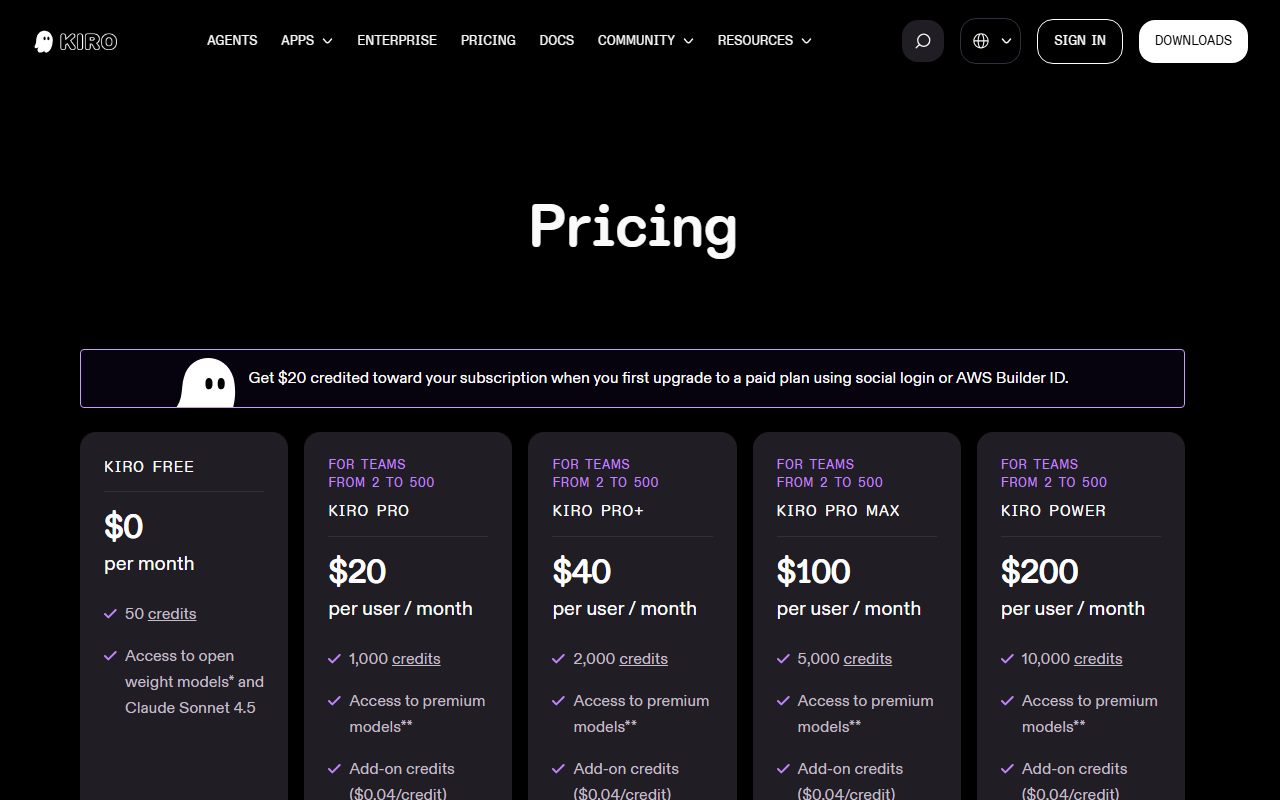
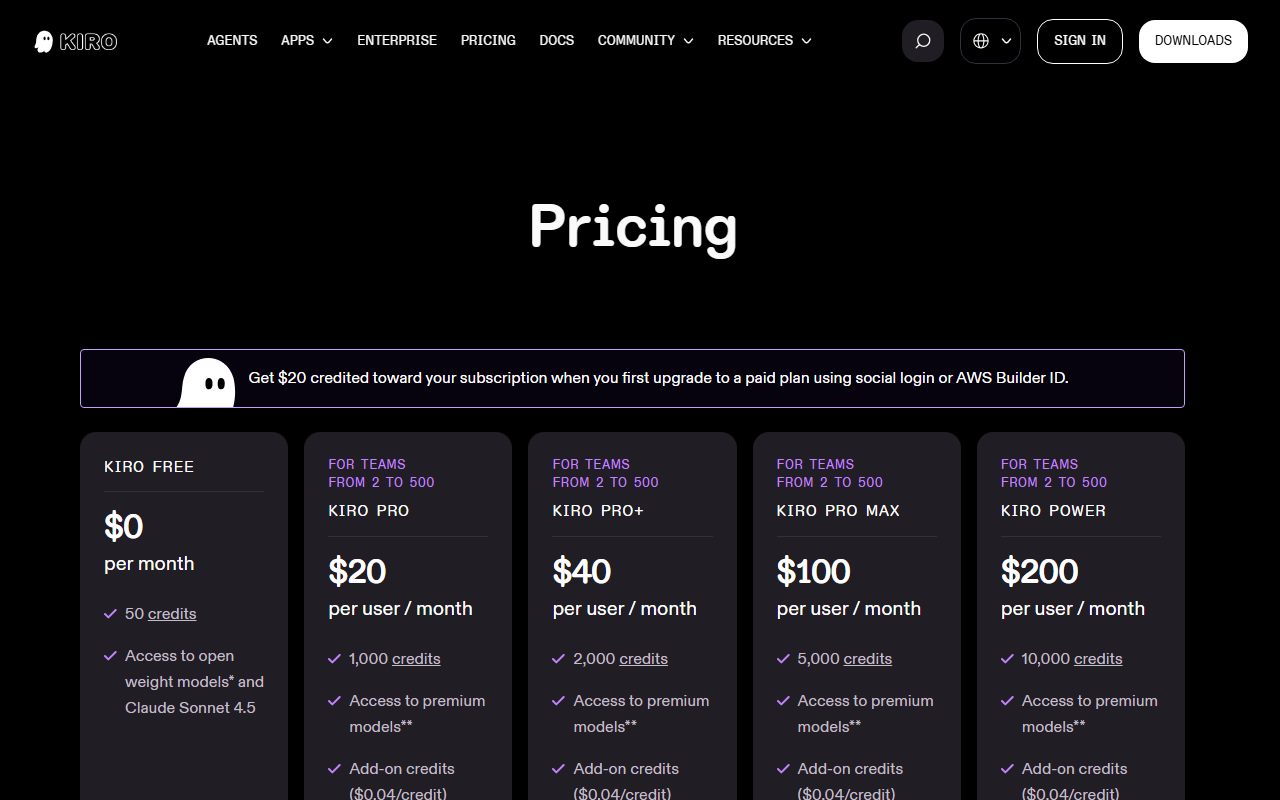
The page prints a credit count on every card. Free is $0 with 50 credits. The four paid tiers are sold per user a month, each marked for teams from 2 to 500.
- Kiro Free: $0 a month, 50 credits.
- Kiro Pro: $20 per user a month, 1,000 credits.
- Kiro Pro+: $40 per user a month, 2,000 credits.
- Kiro Pro Max: $100 per user a month, 5,000 credits.
- Kiro Power: $200 per user a month, 10,000 credits.
Each of those four divisions gives $0.02 per included credit. No tier buys cheaper units than any other, which is a different design from the one in Copilot's AI credits.
Copilot publishes a flat cent per credit and then widens the allowance faster than the price. Kiro holds the rate flat and sells capacity in a straight line.
Free sits outside that line. Fifty credits is a sample, not a working month, and the footnote adds that free access is subject to rate limits.
Add-on credits cost double the included rate
Every paid card carries the same line: add-on credits at $0.04 per credit. Packs are described as ranging from $5 to $100, with the $5 pack listed as 125 credits.
That pack checks out against the stated rate, since 125 at four cents is exactly $5. Two separate statements on one page agreeing is the test worth running.
So the premium for running past your plan is 100 percent. By our arithmetic, a Pro user who doubles their usage with add-ons pays $60 for 2,000 credits, against $40 on Pro+.
The cheaper move, on those published numbers, is to change tier rather than top up repeatedly. That is the same trap described in how to read an AI credit pricing page.
For enterprise accounts the page describes overages billed at $0.04 per credit at month end, disabled by default and enabled in console settings.
Monthly credits expire; bought credits do not
Kiro answers the rollover question directly, which many vendors avoid. Usage limits reset at the start of each billing month, and unused credits do not roll over.
Add-on credits follow a different rule. The page states that unused add-on credits roll over and expire 12 months from the date of purchase.
Two clocks in one account is worth noting before you buy a large pack early in a month. The spread of vendor answers is collected in do unused AI credits roll over.
The page also says paid subscriptions are processed on the first day of each calendar month, so the billing month and the usage month line up.
A credit is a unit of work, and models change the rate
Kiro defines a credit as a unit of work in response to a prompt. Simple prompts can consume less than one credit, and credits are metered to two decimal places.
The page gives one concrete multiplier: a task costing X credits in Auto costs 1.3X when run through Sonnet 4.6. Auto is the default routing agent.
So the published credit count is a ceiling expressed in a currency whose value you set by model choice. That is the same ambiguity as a per-prompt allowance, only priced.
Prompts, spec refinement, task execution and agent hooks all consume credits, and Kiro Web draws from the same pool with no separate compute charge.
Unit-of-work pricing turns up in very different categories too, such as Browse AI's per scrape cost and credit per minute video tools.
Seats, regions and the sign-up credit
Kiro is sold per developer. For team usage, the page states that each developer needs their own subscription, with teams of 2 to 500 on the paid tiers.
Organisations above 500 users are pointed at Kiro for enterprise, which is purchased through AWS and has no published price.
Two regional notes matter. Kiro pricing in AWS GovCloud regions is described as approximately 20 percent higher, and the free tier is not available there or on enterprise.
A first upgrade earns $20 credited toward the subscription via social login or AWS Builder ID. The page's own worked example pro-rates that to $10 for a mid-June start.
Frequently asked questions
How much does a Kiro credit cost?
Two cents when included in a plan, by our arithmetic: $20 for 1,000 credits on Pro, and the same $0.02 rate on Pro+, Pro Max and Power. Add-on credits cost $0.04 each.
What does the Kiro free tier include?
Fifty credits a month at $0, with access to open weight models and Claude Sonnet 4.5 subject to rate limits. Free accounts cannot buy add-on credits and are excluded from GovCloud.
Do Kiro credits roll over?
Plan credits do not. Limits reset at the start of each billing month and unused credits are lost. Purchased add-on credits do roll over and expire 12 months after purchase.
Is it cheaper to top up or move up a tier?
Move up. By our arithmetic, Pro plus 1,000 add-on credits is $60 for 2,000 credits, while Pro+ gives the same 2,000 credits for $40 a month.
Can two developers share one Kiro subscription?
No. The pricing FAQ states that each developer needs their own subscription for team usage. Paid tiers are offered for teams from 2 to 500 users, billed per user.
How many credits does one prompt use?
It varies. Kiro says simple prompts can cost under one credit, metered to 0.01, and that a task costing X credits via Auto costs 1.3X via Sonnet 4.6.
Bottom line
Kiro's page is honest arithmetic: a flat two cents per included credit across four tiers, double that for extras, and a clear answer on expiry.
The soft spot is the unit itself. A credit is a unit of work whose size moves with model choice, so the count tells you less than the price per count suggests.
All figures read October 27, 2026. Related: what image credits actually buy and how AI credits work across four tools.
Sources
- Kiro pricing, plans and credits (checked Oct 27, 2026)
- Kiro pricing page, common questions on credits and add-ons (checked Oct 27, 2026)
- GitHub Copilot plans and pricing, for the credit rate comparison (checked Oct 27, 2026)