What AI Image Credits Actually Buy
Image tools advertise thousands of credits, but a credit is not a picture. Ideogram publishes a table where one image costs between 0.8 and 22 credits; Adobe Firefly charges 100 credits per second of 1080p video. Here is how to convert an advertised allowance into a realistic number of images, using vendor tables read on October 10, 2026.
This article is a documentation review: it is based on the vendors' own published pages, checked on the date shown. We may earn a commission from some links; it never affects what we recommend.

A credit is a unit of compute, not a picture. Ideogram's own table charges 0.8 credits for a draft image and 22 credits for a high-quality image built from source images, so a 2,400-credit plan can mean 3,000 pictures or 109 pictures depending on settings. Adobe Firefly charges 1 credit for a standard generation and 100 credits per second of 1080p video, which turns a 4,000-credit allowance into 40 seconds of footage. Leonardo sells tokens with a rollover bank instead. This guide reads three vendor pages, checked October 10, 2026, and shows how to do the conversion before paying.
Convert the allowance into images before comparing prices
The first question to ask a credit plan is not how many credits it includes, but what one image costs inside it. The spread within a single vendor is wide.
Ideogram's pricing page carries a table titled "Using your credits." It states that generations "use a different number of credits based on the Model and Rendering settings you choose," and its 4.5 rates run from 0.8 to 22 credits per image.
That single table makes the advertised numbers legible. The Plus plan includes 2,400 credits a month. By editorial calculation, that is 240 images at the High rendering rate of 10 credits per image, or 400 at Medium, or 109 at the 22-credit setting.
This is the same arithmetic we applied to text and video tools in how AI credits work at Jasper, Copy.ai, Synthesia and Pictory. The vendor that publishes a per-action rate is doing the buyer a favour.
Ideogram prices every model and rendering setting separately
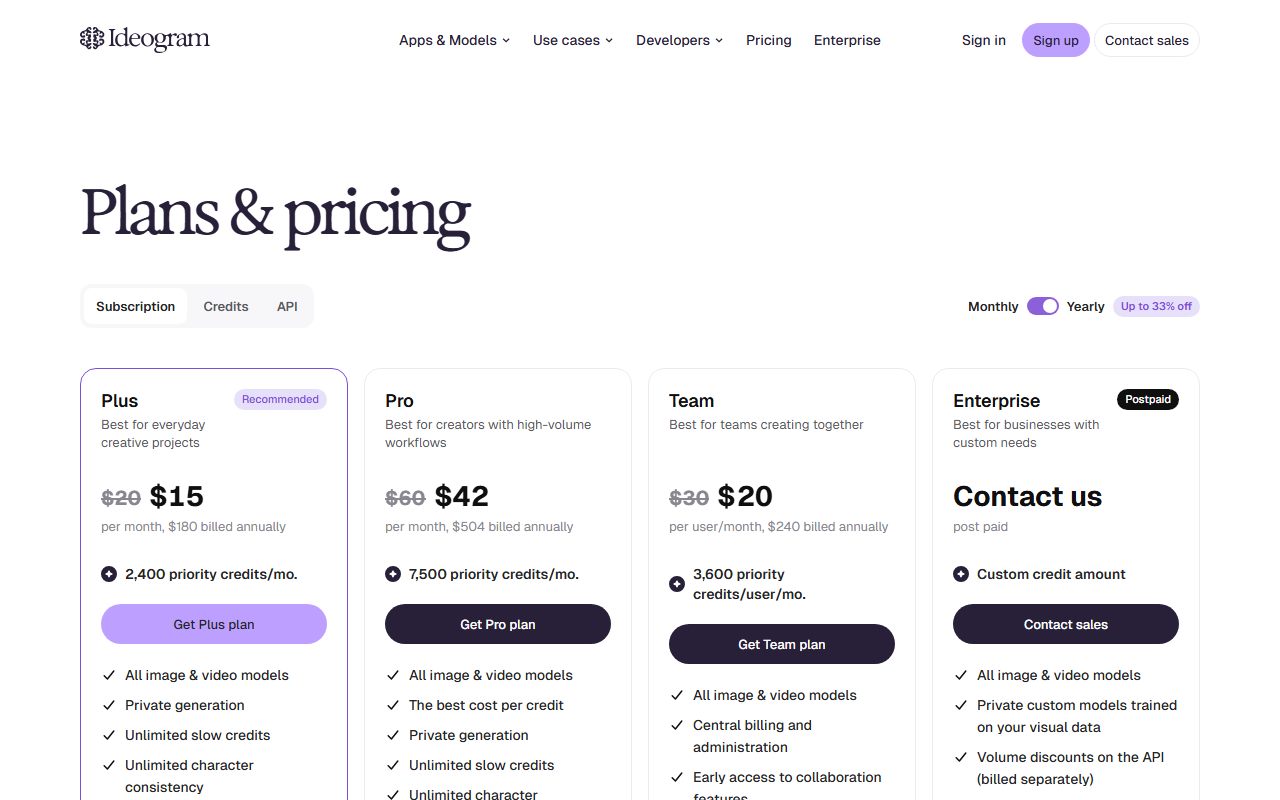
As of October 10, 2026, Ideogram lists Free at $0, Plus at $20 monthly or $15 monthly on $180 billed annually, and Pro at $60 monthly or $42 monthly on $504 billed annually.
Team is listed at $30 per user monthly, or $20 per user billed annually, with a stated two-user minimum.
Plus includes 2,400 credits a month, Pro includes 7,500 and Team includes 3,600 per user. The page calls these "priority credits" and defines them as credits that "let you generate images instantly."
- Model 4.5: 0.8 credits per image at Very Low with source images, 3 at Low, 6 at Medium, 10 at High, 22 at High with source images.
- Model 4.0 at 2K: 3 credits per image on Turbo, 6 on Balanced, 10 on Quality.
- Model 3.0: 12 credits for 4 images on Turbo, 24 on Default, 36 on Quality.
- Model 2.0: 20 credits for 4 images on Turbo, 32 on Default, 48 on Quality.
- Upscale 1.0: 6 credits per image, available on paid plans only.
Two rules in the page's own FAQ change the value of the plan. Unused subscription credits "expire at the end of each billing cycle," while purchased top-up credits carry over.
The second rule is sharper. Once priority credits are gone, generations drop into a slow queue, and the FAQ states that editing features such as Image Reference "require priority credits and are not available in the slow queue."
Leonardo sells tokens with a bank, but no per-image rate
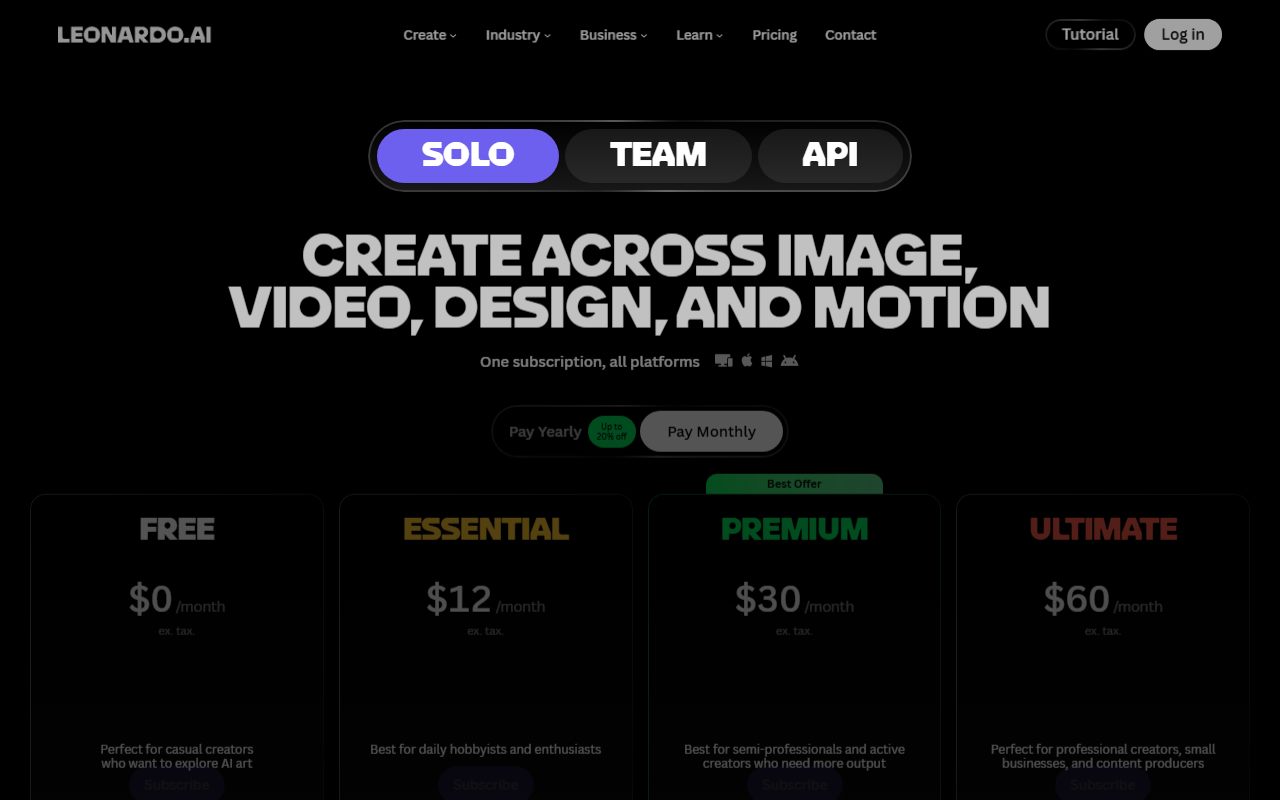
Leonardo's pricing page, read October 10, 2026, lists Free at $0 with 150 Fast Tokens per day, Essential at $12 per month with 8,500 Fast Tokens monthly, Premium at $30 with 25,000, and Ultimate at $60 with 60,000. All figures are marked "ex. tax."
The distinctive mechanic is the Token Bank: 25,500 on Essential, 75,000 on Premium and 180,000 on Ultimate. Each bank is three times the monthly allowance, so unused tokens accumulate rather than expiring the way Ideogram credits do.
Higher tiers also raise throughput rather than only volume. Simultaneous generations run 2 on Essential, 3 on Premium and 6 on Ultimate, with generation queues of 5, 10 and 20. Personal AI model slots go 10, 20 and 50.
Premium and Ultimate add "unlimited" relaxed generations on a named model list including Lucid Origin, Phoenix 1.0 and FLUX Dev, with Ultimate extending that to video. A footnote warns such generations "may be slowed from time to time based on demand."
What the page does not publish is how many tokens one image consumes. Without that rate, 8,500 tokens cannot be converted into a picture count from the pricing page alone, so this guide does not estimate one.
Firefly credits are cheap for images and expensive for video
Adobe splits generative features into standard and premium. Its generative credits FAQ states that most standard features, such as Generative Fill using Firefly models in Photoshop, use "1 credit per generation," while premium features deduct more.
The premium table is where budgets disappear. Firefly Image 5 costs 10 credits per generation and Firefly Image 4 Ultra costs 20 credits per generation for a single image. Rotate Object in Photoshop costs 20 credits per object, applied on first rotation only.
Video is an order of magnitude dearer. Generate Video is listed at 100 credits per second at 1080p and 24 frames per second, 50 at 720p and 20 at 540p. Generative Extend in Premiere reaches 175 per second at 4K.
Audio has its own rates: 20 credits per minute of music, 10 per 1,000 characters of Firefly Speech, 15 with ElevenLabs Multilingual v2, and 10 per sound effect. Our comparison of ElevenLabs and Descript audio credits covers that market.
By editorial calculation, a 4,000-credit monthly allowance buys 400 Firefly Image 5 generations, 200 Image 4 Ultra images, or 40 seconds of 1080p video. The same number looks generous or useless depending entirely on the output.
Check what resets, what rolls over and what is unmetered
Adobe's FAQ is explicit that generative credits "do not roll over to the next month" and reset on the billing date. A failed generation is refunded, usually within minutes, though the page warns video refunds can take up to 24 hours.
Adobe publishes allowances by plan too. Creative Cloud Pro includes 4,000 premium credits plus unlimited standard generations, Creative Cloud Standard includes 25, and Photography 1TB includes 1,000.
The Firefly plans page lists Firefly Standard at 2,000 credits a month, Pro at 4,000, Pro Plus at 10,000 and Premium at 50,000 with unlimited Firefly Video model access.
Those credit counts are quoted here but the prices beside them are not. The Adobe page served Turkish lira from our location on October 10, 2026, so no dollar figures were available to verify, and none are invented here.
One further caveat from Adobe's own wording: unlimited standard generations stay unlimited everywhere except inside Firefly Graph, where "the standard generations continue to be metered." Unlimited is a per-surface promise, not a global one.
Why Midjourney is missing from this comparison
Midjourney was intended to appear here. Both its subscription plans documentation and the pricing path on its main site were unreadable on October 10, 2026: the documentation returned a Cloudflare bot verification page and the site path returned a 404.
Rather than quote figures from memory or search snippets, the product is left out. A price that cannot be verified on the vendor's own page does not belong in a pricing guide.
The same discipline applies to the text tools covered in what an AI writing prompt allowance means and the assistant tiers in ChatGPT Plus versus Pro.
Frequently asked questions
How many images does 2,400 credits make?
On Ideogram's 4.5 model it depends on rendering: 240 images at the 10-credit High setting, 400 at the 6-credit Medium setting, or 109 at the 22-credit setting that uses source images. That is an editorial calculation from the published credit table.
Do unused AI image credits roll over?
It varies by vendor. Adobe states generative credits do not roll over and reset monthly. Ideogram subscription credits expire each billing cycle, though purchased top-ups carry over. Leonardo keeps a Token Bank worth three times the monthly allowance.
Why is AI video so much more expensive than images?
Because video is billed per second. Adobe lists 100 credits per second for 1080p video at 24 frames per second against 1 credit for a standard image generation, so one minute of footage costs 6,000 credits.
What happens when image credits run out?
On Ideogram, generations move to a slow queue and AI editing features stop working until credits reset or top-ups are bought. On paid Adobe plans, standard generations continue unmetered outside Firefly Graph while premium features stop.
Which tool is cheapest for high-volume image work?
No honest answer exists from pricing pages alone, because Leonardo does not publish a token cost per image. Ideogram is the only vendor here where cost per picture can be calculated before subscribing.
Bottom line
Treat an advertised credit figure as meaningless until it is divided by a published per-action rate. Ideogram publishes one, Adobe publishes a detailed one, Leonardo does not, and Midjourney's page could not be read at all.
Before subscribing, decide the output you need, find the rate for that exact model and quality setting, and do the division yourself. Every figure above is as of October 10, 2026.
For plan ladders that sell usage instead of credits, see Claude Free, Pro and Max and Perplexity free versus paid limits.
Sources
- Ideogram plans and pricing, including the credits per generation table (checked Oct 10, 2026)
- Leonardo.Ai pricing, individual and team plans (checked Oct 10, 2026)
- Adobe generative credits FAQ, credit costs per feature and per plan (checked Oct 10, 2026)
- Adobe Firefly plans, credit allowances (prices served in Turkish lira from our location) (checked Oct 10, 2026)
- Midjourney subscription plans documentation (Cloudflare bot check, could not be read) (checked Invalid Date)