GitHub Copilot AI Credits: What One Credit Buys
GitHub Copilot now meters agent work in AI credits and publishes the exchange rate, so every allowance on the plans page can be read as money. Pro carries $15 of credits a month, Pro+ $70 and Max $200, each split into a base amount and a flex allotment. Code completions sit outside the meter. All figures were read from the rendered plans page on October 27, 2026.
This article is a documentation review: it is based on the vendors' own published pages, checked on the date shown. We may earn a commission from some links; it never affects what we recommend.

GitHub Copilot meters agent work in AI credits, and the plans page prints the exchange rate in one line: 1 AI credit = $0.01 USD.
That line does more work than the plan table above it. It turns every allowance on the page into a dollar figure, which means the tiers can be compared with a calculator.
Every figure below was read from the rendered GitHub Copilot plans page with a headless browser on October 27, 2026. Totals labelled as arithmetic are ours, not the vendor's.
The allowance is published as money, not as a count
The page lists four individual tiers. Free is $0, Pro is $10 per user a month, Pro+ is $39 and Max is $100.
Each paid card then states the allowance in dollars: $15 monthly total credits for Pro, $70 for Pro+ and $200 for Max.
The credit row for Free carries no number. It reads "Limited chat and agent usage". Free does get one hard figure elsewhere on the card: 2,000 completions per month.
At a cent a credit, Pro's $15 is 1,500 credits. A footnote on the page says the same thing independently: "1,500 monthly AI credits ($15 value)".
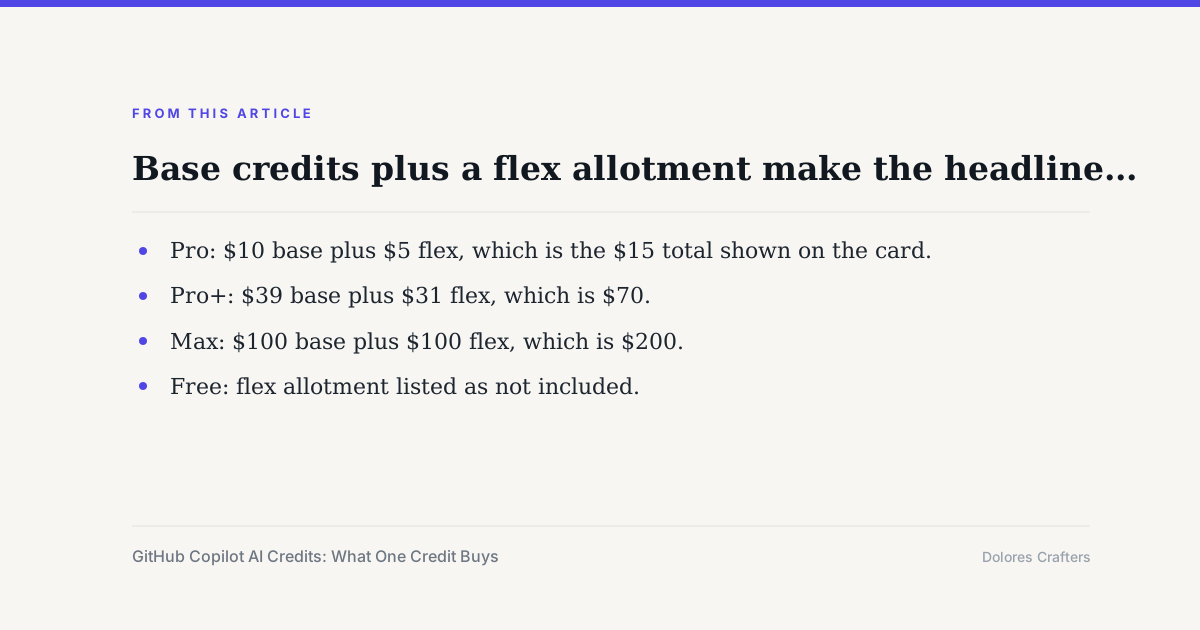
Base credits plus a flex allotment make the headline figure
The comparison table splits each allowance in two. A base amount matches the seat price, and a flex allotment sits on top of it.
- Pro: $10 base plus $5 flex, which is the $15 total shown on the card.
- Pro+: $39 base plus $31 flex, which is $70.
- Max: $100 base plus $100 flex, which is $200.
- Free: flex allotment listed as not included.
Those three sums add up, which is the first check worth running on any credit page. The wider method is in how to read an AI credit pricing page.
The page also warns that "flex allotments may change over time". Read the base as the contracted part and the flex as the part that can move without a price change.
Credits get cheaper as you climb, which is unusual
By our arithmetic, a Pro+ seat costs 3.9 times a Pro seat and carries 4.67 times the credit value. A Max seat costs 10 times a Pro seat and carries 13.3 times the value.
GitHub prints the same ratios in the comparison table, as "Over 4.6x included monthly credits than Pro" and "Over 13.3x included monthly credits than Pro".
So the effective rate per credit falls at every step up. That is the opposite of the pattern in many creative tools, where a higher tier mostly unlocks features.
For the same question asked of chat subscriptions, see Claude Free, Pro and Max and ChatGPT Plus against Pro.
Code completions sit outside the meter
The credits FAQ on the page states that code completions and next edit suggestions do not use credits, and that they remain unlimited with a paid plan.
The named consumers of credits are agent mode, code review, Copilot in the cloud, Copilot CLI and the Copilot app, with usage varying by model.
That split matters for estimates. An autocomplete-heavy habit may never reach the allowance, while one long agent session on a premium model can move it noticeably.
Metering some features and not others is common across AI tools. It is also how image credits and prompt allowances behave.
Business and Enterprise include credit value equal to the seat
On the business tab, Business is $19 per user a month and Enterprise is $39. For both, the total AI credits row repeats the price exactly: $19 and $39 per user per month.
So an organisation seat includes credit value equal to what it costs. No flex allotment is printed above the seat price on either of those two rows.
Pooled usage is listed as not included on Free, Pro, Pro+ and Max. Pooling appears on the organisation plans, where included credits are shared org-wide with admin controls for spending.
That fork between a personal allowance and a shared one is the same one described in what Notion AI adds to a seat.
Overage is priced in plain dollars
Paid individual plans may purchase additional credits; Free may not. The page describes setting a dollar budget so work continues without interruption.
Its own example needs no conversion: credits draw down at $0.01 each, so a $10 budget covers 1,000 credits. That is the clearest overage wording on any credit page we read this month.
The rendered plans page carried no rollover wording and no annual billing toggle on October 27, 2026. We are describing that page, not the whole of GitHub's billing documentation.
Other vendors do answer the rollover question in writing, and the answers differ a lot: see do unused AI credits roll over.
What to carry into a budget
- Convert the allowance to credits yourself: divide the dollar figure by $0.01.
- Separate completion use from agent use, because only the second one is metered.
- Check whether the base or the flex part is doing the work on the tier you want.
- Price the overage budget as a line item, not as an exception.
- If you need pooling, look at the organisation plans rather than Max.
For how credit pricing looks in tools that count units instead of cents, see how AI credits work across Jasper, Copy.ai, Synthesia and Pictory.
Frequently asked questions
How much is one GitHub Copilot AI credit?
The plans page states that 1 AI credit equals $0.01 USD, and repeats it in an overage example where a $10 budget covers 1,000 credits. Read October 27, 2026.
What does Copilot Pro include?
Pro is $10 per user a month and includes $15 of monthly total credits, split as $10 base plus a $5 flex allotment. That is 1,500 credits at the published rate.
Is the Copilot free plan metered in credits?
Not with a number. The credit row for Free reads "Limited chat and agent usage". The card does state 2,000 completions per month, and Free cannot purchase additional credits.
Do code completions use Copilot credits?
No. The page states that code completions and next edit suggestions do not consume credits and stay unlimited on paid plans. Credits cover chat, agents, code review and the CLI.
Is Pro+ or Max better value per credit?
Max, by our arithmetic. It costs 10 times a Pro seat for 13.3 times the credit value, against Pro+ at 3.9 times the price for 4.67 times the value.
Can a team share Copilot credits?
Not on individual plans. Pooled usage is listed as not included on Free, Pro, Pro+ and Max. Organisation plans share included credits org-wide with admin spending controls.
Bottom line
Copilot's credit page is readable in a way most are not, because it publishes the unit price. One cent a credit, and every allowance becomes a number you can defend in a budget.
For most individual buyers, Pro at $10 with $15 of credits is the sane entry. Heavy agent use is where Max's cheaper per credit rate starts to matter.
All figures read October 27, 2026. Related: what annual billing really saves and Perplexity Pro against Free.
Sources
- GitHub Copilot plans and pricing (checked Oct 27, 2026)
- GitHub Copilot plans page, feature comparison table (checked Oct 27, 2026)