Cursor Pricing: When Usage Is Just a Multiple
Cursor publishes five individual prices and not one usage number. The plan table expresses capacity as a multiple of the Plus tier, which is itself listed only as Basic, so nothing on the page can be costed per unit. Third-party models are excluded from the monthly price entirely. Figures were read from the rendered pricing page on October 27, 2026.
This article is a documentation review: it is based on the vendors' own published pages, checked on the date shown. We may earn a commission from some links; it never affects what we recommend.

Cursor's pricing page names five prices and no quantities. Capacity on the paid tiers is given as a multiple of the Plus plan, and Plus itself is described only as Basic.
A multiple of an unpublished number is not a number. It ranks the tiers correctly and tells you nothing about what any of them will do in a month.
The figures below were read from the rendered pricing page with a headless browser on October 27, 2026, and confirmed on a second dump the same day.
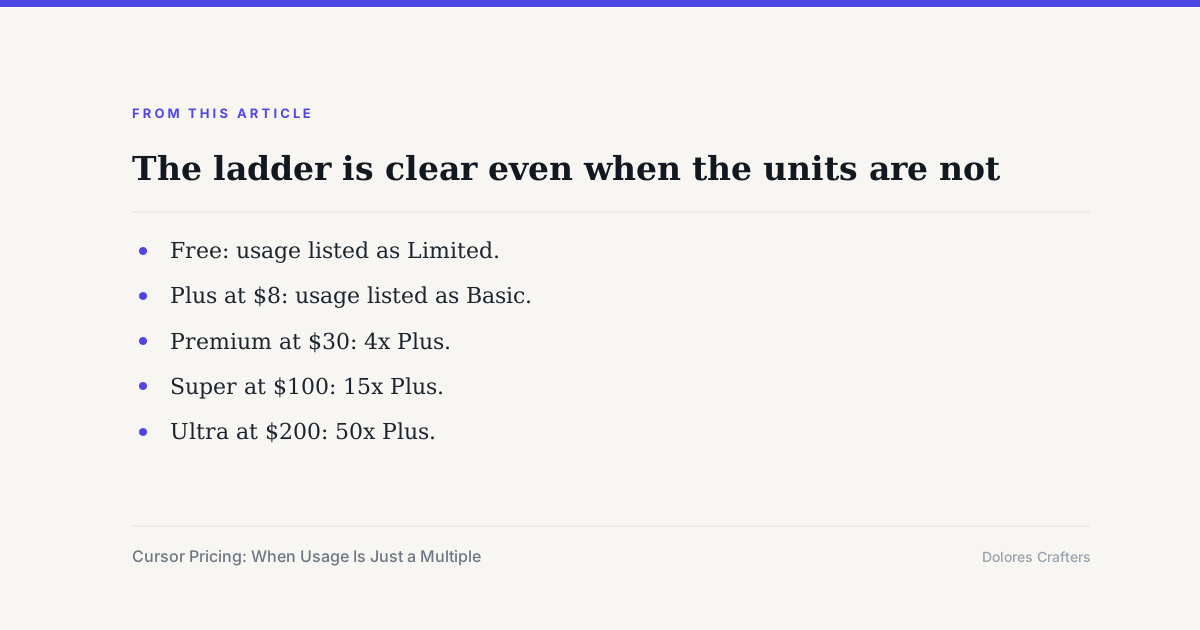
The ladder is clear even when the units are not
The individual tab lists Free at $0 a month, Plus at $8, Premium at $30, Super at $100 and Ultra at $200. Teams is listed at $30 and up per user a month.
Enterprise shows Custom with a contact link, so it carries no published price. The usage row in the comparison table is where the vagueness begins.
- Free: usage listed as Limited.
- Plus at $8: usage listed as Basic.
- Premium at $30: 4x Plus.
- Super at $100: 15x Plus.
- Ultra at $200: 50x Plus.
- Teams at $30 and up per user: 4-50x Plus.
- Enterprise: Pooled.
The plan cards repeat the same ratios in words, as 4x, 15x and 50x more usage compared to Plus. Nowhere does the page say what Plus includes.
Compare that with a page that does publish units, such as Kiro's credit counts or Copilot's cent per credit.
The multiples do not track the prices
The ratios move faster than the money, which is worth noticing. By our arithmetic, Ultra costs 25 times a Plus seat and is credited with 50 times the usage.
Premium costs 3.75 times Plus for 4 times the usage, and Super costs 12.5 times Plus for 15 times the usage. Every step up buys relatively more capacity.
That direction of travel matches Copilot, where higher tiers also buy cheaper capacity. The difference is that Copilot's version can be checked against a dollar figure.
Here the comparison is only internal. You can say Ultra is twice as efficient as Plus per dollar, and still not know whether either one covers your week.
Third-party models are not in the monthly price at all
This is the most consequential line on the page, and it sits in small print. Third-party model usage in Cursor is not included in the monthly prices shown and must be purchased separately.
Three plan cards repeat it as a footnote: third-party models are available in Cursor, billed separately by usage. The comparison table adds a row for third-party models at API list price.
That row is marked present on Premium, Super, Ultra, Teams and Enterprise, and absent on Free and Plus. Plus carries its own footnote: only Grok models are available on this plan.
So the real bill has two parts. The subscription buys first-party capacity, and anything routed to an outside provider is pass-through at list price.
Separating included usage from pass-through billing is the single most useful habit on these pages, as set out in how to read an AI credit pricing page.
The subscription is not only a coding tool
The same plans bundle Grok features and social account perks alongside the editor. Plus lists Grok Chat, Voice, Imagine and Build, plus Grok API access.
Premium adds video generation, Grok Bot, faster chat responses, cloud agents and automations, code hosting via Origin and AI code reviews via Bugbot.
It also lists perks that have nothing to do with code: a premium checkmark, ad-free scrolling on most surfaces, a preferred handle and higher reply boost.
Buyers comparing this against a pure coding tool are not comparing like with like. Part of the price buys a consumer subscription, which may or may not be worth anything to a team.
Bundles that fold an AI feature into a wider seat are common. The clearest example we have written up is what Notion AI adds to a seat.
What the page does not let you calculate
We could not read a usage figure of any kind for Plus, so no absolute capacity can be derived for any tier. Every number on the page is relative.
We also could not read a per-unit overage rate for first-party usage, or any statement about whether unused capacity carries into the next month.
This is a reading of the rendered pricing page on one day, not of the whole documentation set. It is the page a buyer actually sees before paying.
Vendors that do answer the carry-over question are collected in do unused AI credits roll over, and the answers are not consistent.
The page does state that prices exclude applicable taxes and fees, and that cancellation must be at least 24 hours before renewal to avoid a further charge.
Frequently asked questions
How much does Cursor cost?
Five individual prices were listed on October 27, 2026: Free at $0, Plus at $8, Premium at $30, Super at $100 and Ultra at $200 a month. Teams starts at $30 per user.
How much usage does Cursor Plus include?
The page does not give a figure. The usage row reads Basic for Plus and Limited for Free, and every paid tier above is described only as a multiple of Plus.
What does 4x Plus mean on the Premium plan?
Four times whatever Plus includes. Since Plus has no published allowance, the multiple ranks the tiers without letting you cost a month of work in advance.
Are all models included in the Cursor subscription?
No. The page states that third-party model usage is not included in the monthly prices and must be purchased separately, billed at API list price on Premium and above.
Which tier gives the most usage per dollar?
Ultra, on the published ratios. By our arithmetic it costs 25 times a Plus seat for 50 times the usage, against 3.75 times the price for 4 times the usage on Premium.
Does a Cursor plan include anything besides coding?
Yes. The plan cards list Grok chat, image and video generation, API access, and account perks such as a premium checkmark and ad-free scrolling on most surfaces.
Bottom line
Cursor's ladder is coherent and its multiples are generous at the top. What it withholds is the one thing a budget needs, which is a unit.
Treat the subscription as a floor rather than a price. Anything routed to a third-party model lands on top of it at list rates.
All figures read October 27, 2026. Related: what ChatGPT Plus and Pro include and where Perplexity's limits sit.
Sources
- Cursor pricing, individual and team plans (checked Oct 27, 2026)
- Cursor pricing page, compare features across plans table (checked Oct 27, 2026)